Backtest Lab Docs
Shared Account
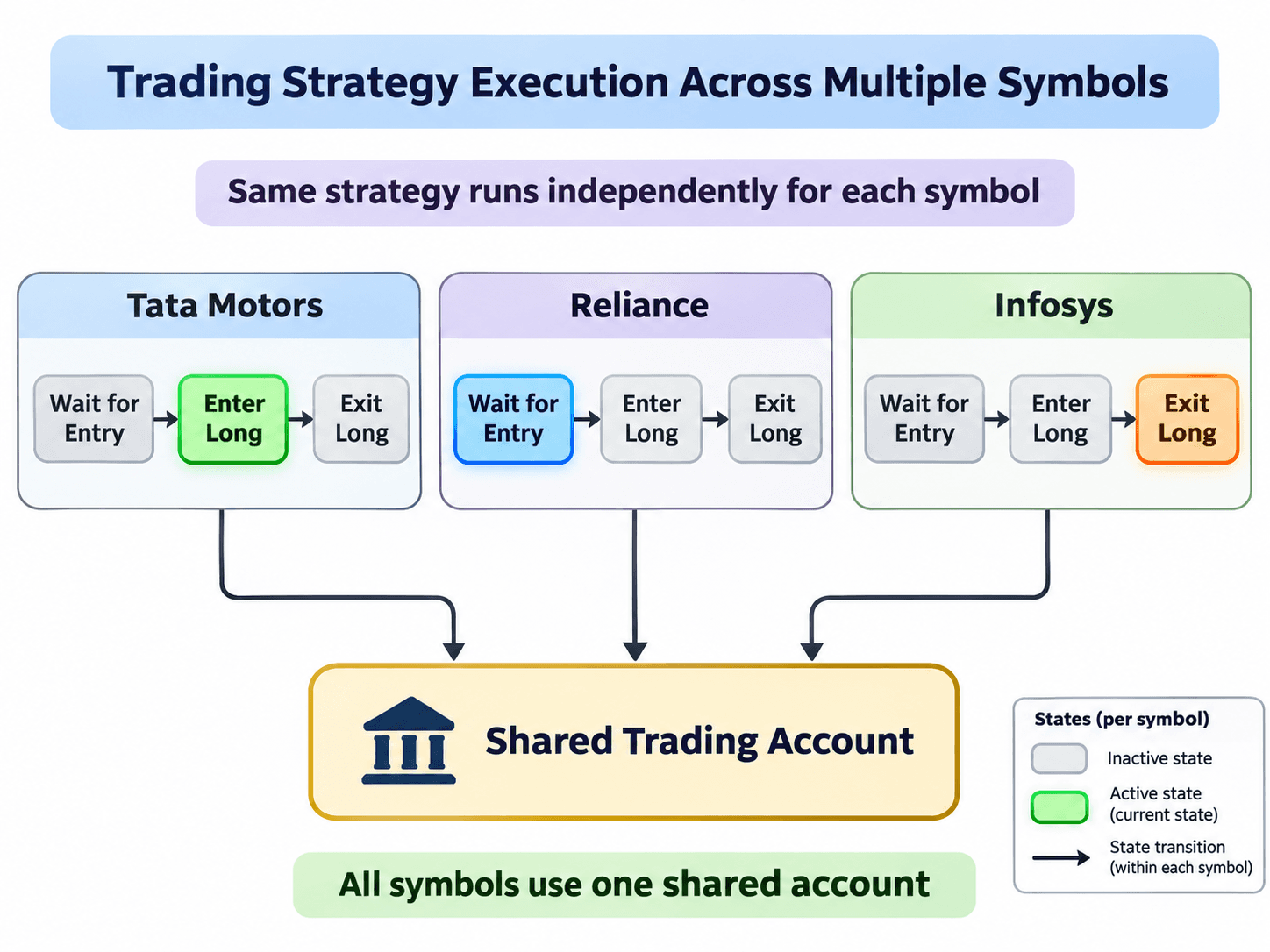
When a strategy runs on multiple symbols, each symbol follows its own independent strategy logic. However, all symbols share a single trading account and draw from the same pool of available capital.
The account belongs to the strategy as a whole, rather than to any individual symbol.
How Capital Is Shared
Suppose you configure a trading account with an initial balance of ₹1,00,000 and run a strategy on three symbols: Tata Motors, Reliance, and Infosys.
If the strategy generates a trade entry for Tata Motors that requires ₹30,000, that capital is drawn from the shared account when the trade is executed.
The remaining ₹70,000 is then available for trades in Reliance, Infosys, or Tata Motors itself, subject to any other capital already committed.
What Happens When Capital Is Insufficient?
Because all symbols use the same account, the order in which their trading signals are processed can affect which trades are successfully executed.
Consider an account with ₹50,000 available and two symbols generating entry signals that each require ₹30,000.
If the first trade is executed successfully, only ₹20,000 remains. The second trade cannot be executed because the account no longer has sufficient capital.
An entry signal does not guarantee that a trade will be executed.
When a strategy enters a state configured with a trade-entry action, it requests the corresponding trade. If sufficient capital is not available, the trade is rejected.
Importantly, a rejected trade does not automatically change the strategy's active state. The state machine continues to follow its configured conditions and transitions independently of whether the requested trade was successful.
Account Configuration
Backtest Lab supports different account configurations that determine how trading capital is allocated and how trade quantities are calculated.
The shared-capital behavior described here applies to accounts with a finite trading balance. Other account configurations may use different capital constraints.
For details about the available account types and their sizing rules, see Backtest Accounts.